
Tony Fisher Tony Fisher
0 Course Enrolled • 0 Course CompletedBiography
Linux Foundation CKAD試験解説問題 & CKADテスト模擬問題集
P.S. ShikenPASSがGoogle Driveで共有している無料かつ新しいCKADダンプ:https://drive.google.com/open?id=1ub_1gY5POkpor_il3zjdvvWLyvD5K9Io
あなたに相応しいShikenPASS問題集を探していますか。CKAD試験備考資料の整理を悩んでいますか。専業化のIT認定試験資料提供者ShikenPASSとして、かねてより全面的の資料を準備します。あなたの資料を探す時間を節約し、Linux Foundation CKAD試験の復習をやっています。
CKAD認定試験は、実践的なパフォーマンスベースの試験です。つまり、候補者は実践的な演習を通じてスキルを実証する必要があります。試験はオンラインで実施され、候補者には作業するKubernetesクラスターが提供されます。試験は、2時間以内に完了する必要がある一連の実用的なタスクで構成されています。タスクは、候補者がKubernetesアプリケーションを展開、構成、および管理する能力をテストし、一般的な問題をトラブルシューティングするように設計されています。
>> Linux Foundation CKAD試験解説問題 <<
Linux Foundation CKADテスト模擬問題集、CKAD合格受験記
あなたはLinux FoundationのCKAD試験を準備しているとき、あなたの時間とお金を無駄にしないであなたに試験に一番有効な助けを提供するのは我々がLinux FoundationのCKADソフトを作成する達成したい目標です。我々のソフトは多くの受験生にLinux FoundationのCKAD試験に合格させました。我々の通過率はいくつ高くても、我々はあなたが試験に失敗したら全額で返金するのを保証します。これはあなたに安心で弊社の商品を購入させるためです。
Linux Foundation CKAD(Linux Foundation Certified Kubernetes Application Developer)認定試験は、Kubernetes上でのアプリケーションの設計と展開に関する専門知識を持つプロフェッショナルが証明するための高度に求められる認定試験です。Kubernetesは、コンテナ化されたアプリケーションの展開、スケーリング、管理を自動化するオープンソースのプラットフォームです。CKAD認定試験は、候補者のKubernetesアプリケーション開発と展開のスキルを検証するために設計されています。
Linux Foundation Certified Kubernetes Application Developer Exam 認定 CKAD 試験問題 (Q129-Q134):
質問 # 129
You have a multi-container Pod that runs a web server (Nginx) and a database (MySQL) container. The database container requires data to be initialized before the web server container can Stan. How would you configure the Pod to ensure the database container is initialized before tne web server container starts?
正解:
解説:
See the solution below with Step by Step Explanation.
Explanation:
Solution (Step by Step) :
1. Use initContainers:
- Define one or more 'initContainers' within the Pod'S 'spec.template.spec' section.
- The 'initContainerS will run before any other container in the Pod.
- In this case, you would create an 'initcontainer' for the MySQL database.
2. Configure the initContainer:
- The 'initcontainer' should have the following attributes:
- Name: A unique name for the container.
- Image: The Docker image containing the necessary tools to initialize the database.
- Command: The command to execute for database initialization.
- LivenessProbe: Optional, but recommended to check if the database initialization process is successful.
3. Sequence the containers:
- Ensure the 'initContainers' are listed before the main containers in the Pod's 'spec-template-spec-containers' section.
4. Exam le YAML: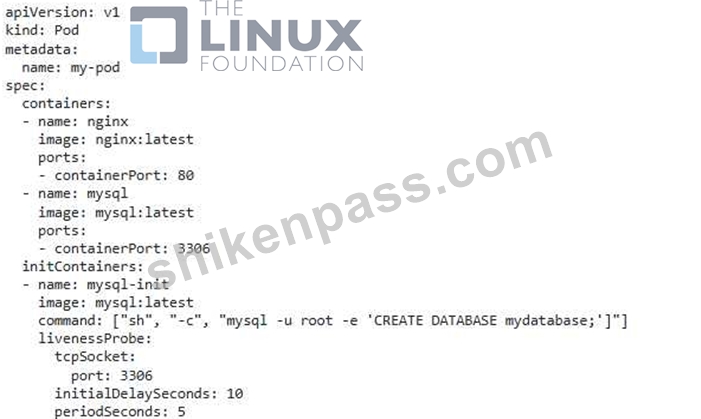
- The 'mysql-init' 'initcontainer' will run before the 'nginx' and 'mysql' containers- - The 'command' in the 'injtContainer' Will create a database named within tne MySQL container. - The livenessprobe' will ensure that the database iS reachable on pon 3306 atter the initialization process completes. Note: This solution assumes that the 'mysqr image already includes the necessary database initialization tools. You might need to use a custom image with these tools if the default image doesn't provide them.,
質問 # 130
You are running a web application within a Kubernetes cluster. The application consists of two pods, each with a resource request of 1CPU core and I GiB of memory. However, you've noticed that the application experiences performance issues during peak traffic hours. To mitigate these issues, you decide to implement resource quotas tor the namespace where the application runs. You want to ensure that the application pods receive adequate resources while preventing other applications from consuming excessive resources. Design and implement a resource quota for the namespace that sets limits for CPU and memory resources.
正解:
解説:
See the solution below with Step by Step Explanation.
Explanation:
Solution (Step by Step) :
1. Define the Resource Quota:
- Create a YAML file (e.g., resource-quota.yaml') containing the following resource quota configuration: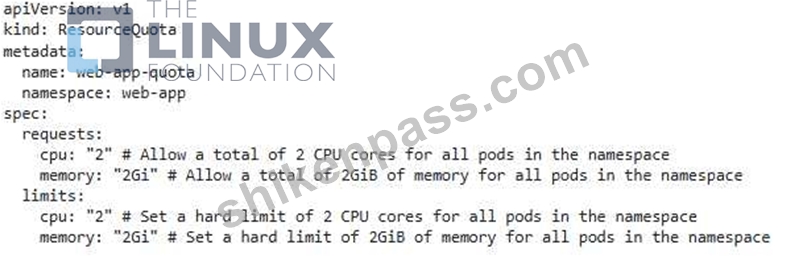
2. Apply the Resource Quota: - Apply the resource quota to the 'web-app' namespace using the following command: bash kubectl apply -f resource-quota-yaml 3. Verify the Resource Quota: - Check the status of the resource quota using the following command: bash kubectl get resourcequotas -n web-app You should see the 'web-app-quota' listed with its defined limits and requests. 4. Monitor Resource Usage: - Use the 'kubectl describe resourcequota web-app-quota -n web-apps command to monitor the current resource usage within the 'web-apps namespace- This will show you the consumed resources against the defined limits. 5. Adjust the Resource Quota: - If the resource quota is too restrictive or not restrictive enough, you can adjust the values in the 'requests' and 'limits' fields in the 'resource. quota.yaml file and reapply the resource quota using 'kubectl apply'. - The resource quota limits the total amount of resources (CPU and memory) that can be consumed by all pods in the 'web-app' namespace. - The requests' field specifies the total amount of resources that pods in the namespace can request. - The 'limits' field sets a hard limit on the total amount of resources that pods can use, preventing them from exceeding these limits. - This ensures that the web application has access to the required resources while preventing other applications in the namespace from consuming all available resources. ,
質問 # 131
You have a Deployment named 'api-deployment' that runs an API server. The API server handles sensitive data and must have strong security measures. You want to ensure that all pods within the Deployment are running with a specific security context that limits their capabilities. Describe the steps to configure a Securitycontext in the Deployment to enforce these security restrictions.
正解:
解説:
See the solution below with Step by Step Explanation.
Explanation:
Solution (Step by Step) :
1. Define the SecurityContext:
- Add a 'securityContext' section to the container definition Within the Deployment's template.
- Define the desired security restrictions Within the 'securityContext sectiom
- 'runAsLJser': Specifies the user ID under which the container should run.
- 'runAsGroup': Defines the group ID for the container.
- 'tsGroup': Sets the supplemental group ID for the container, giving access to specific files and directories.
- 'readOnlyRootFilesystem': Specifies whether the container should have read-only access to the root filesystem.
- 'capabilities': Configures the allowed capabilities for the container, limiting its privileges.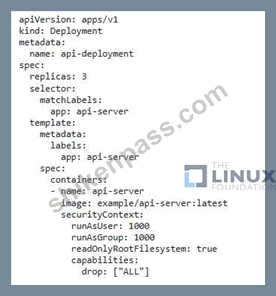
2. Apply the Deployment: - Use 'kubectl apply -f api-deployment_yamr to update the Deployment with the security context configuration. 3. Verify the Security Context: - Examine the pod details using 'kubectl describe pod -I app=api-server' to confirm that the SecurityContext is applied to the containers. 4. Test Security Measures: - Run tests to ensure the security context is effectively limiting the capabilities of the API server pods.
質問 # 132
You are deploying a sensitive application that requires strong security measures. You need to implement a solution to prevent unauthorized access to the container's runtime environment. How would you use Seccomp profiles to enforce security policies at the container level?
正解:
解説:
See the solution below with Step by Step Explanation.
Explanation:
Solution (Step by Step) :
1. Create a Seccomp Profile:
- Create a new YAML file (e.g., 'seccomp-profile.yaml') to define your Seccomp profile.
- Specify the name of the Seccomp profile and the namespace where it will be applied.
- Define the allowed syscalls for the container. You can use the 'seccomp' tool or the
'k8s.io/kubernetes/pkg/security/apparmor/seccomp' package to generate the profile.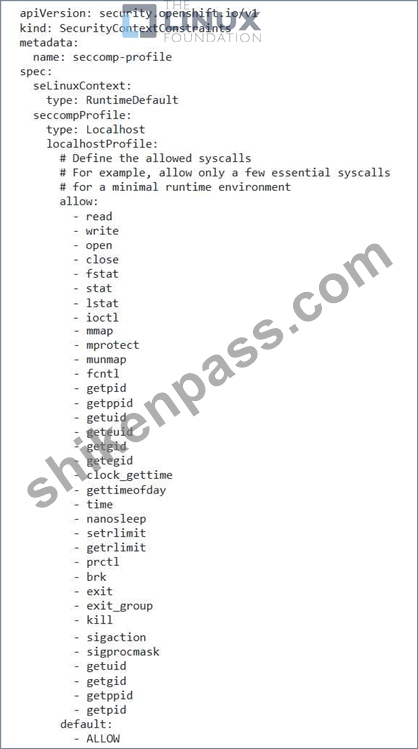
2. Apply the Seccomp Profile: - Apply the Seccomp profile to your cluster using the following command: bash kubectl apply -f seccomp-profile.yaml 3. Deploy Applications with Seccomp Profile: - Update your Deployment YAML file to include the Seccomp profile: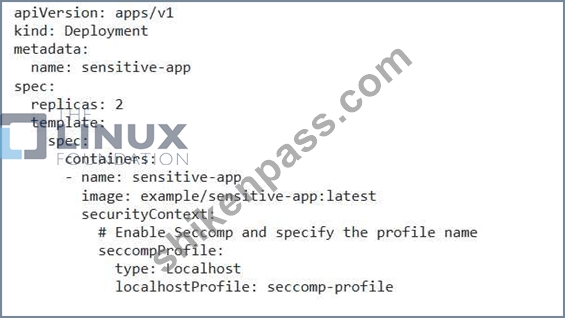
4. Verify the Seccomp Profile: - Check the status of the pods with 'kubectl describe pod - Look for the "Security Context" section and verify that the Seccomp profile is correctly applied. 5. Test the Restrictions: - Try to access system resources or make syscalls that are not allowed by your Seccomp profile. - Verify that the profile is effectively restricting the container's access to system resources.
質問 # 133
You are building a container image for a Python application that requires several external libraries. You want to ensure that the image is as small as possible while still containing all necessary dependencies. What strategy should you use to optimize the image size? Explain your approach and provide a code example.
正解:
解説:
See the solution below with Step by Step Explanation.
Explanation:
Solution (Step by Step) :
I). Use a multi-stage Dockerfile: This allows you to have separate build and runtime stages. The build stage can include all necessary tools and dependencies for building the application, while the runtime stage only includes the essential components needed to run the application.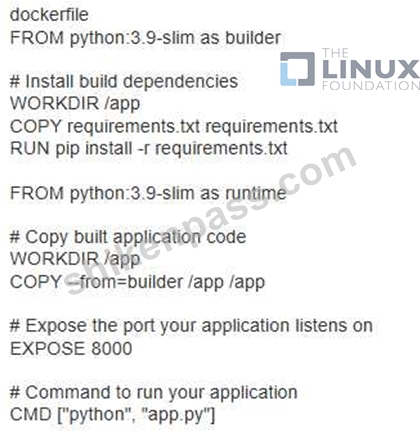
2. Minimize the base image: Choose a base image With only the necessary operating system components, tools, and libraries. I-Ising a slim image variant like 'python:3.9-slim' reduces the image Size significantly. 3. Use a lightweight package manager: Employ a lightweight package manager like 'pip' for installing Python dependencies. This helps keep the image lean 4. Optimize dependencies: Analyze your 'requirements.txt' file and remove any unnecessary dependencies or packages. This is crucial for reducing the overall size of the image. 5. Use caching wisely: In the 'Dockerfile', leverage caching by placing 'COPY commands for your application code before 'RUN' commands. This prevents unnecessary rebuilds of the image when only the application code changes. 6. Consider dependency bundling: If your application relies on specific library versions, consider using a tool like 'pip-tools' to lock down dependencies. This avoids issues where updates to external libraries introduce compatibility problems. 7. Remove unnecessary files: After building your image, inspect the image layers and identify any unneeded files. Remove these files using 'docker image prune' to further reduce image size.
質問 # 134
......
CKADテスト模擬問題集: https://www.shikenpass.com/CKAD-shiken.html
- CKAD模擬問題集 ✨ CKAD試験勉強書 🌍 CKAD専門試験 🕯 ☀ www.japancert.com ️☀️サイトにて“ CKAD ”問題集を無料で使おうCKAD復習資料
- CKAD専門知識 🤎 CKAD資格参考書 🚛 CKAD専門知識 🔙 《 www.goshiken.com 》サイトで▛ CKAD ▟の最新問題が使えるCKAD技術内容
- 最新CKAD|素晴らしいCKAD試験解説問題試験|試験の準備方法Linux Foundation Certified Kubernetes Application Developer Examテスト模擬問題集 📍 Open Webサイト[ www.japancert.com ]検索✔ CKAD ️✔️無料ダウンロードCKAD模擬問題集
- CKAD試験の準備方法|最高のCKAD試験解説問題試験|高品質なLinux Foundation Certified Kubernetes Application Developer Examテスト模擬問題集 ↩ ➠ CKAD 🠰を無料でダウンロード[ www.goshiken.com ]で検索するだけCKAD的中関連問題
- 最新CKAD|素晴らしいCKAD試験解説問題試験|試験の準備方法Linux Foundation Certified Kubernetes Application Developer Examテスト模擬問題集 😆 ➡ www.xhs1991.com ️⬅️に移動し、{ CKAD }を検索して無料でダウンロードしてくださいCKAD資格関連題
- 最新CKAD|素晴らしいCKAD試験解説問題試験|試験の準備方法Linux Foundation Certified Kubernetes Application Developer Examテスト模擬問題集 🌗 時間限定無料で使える➡ CKAD ️⬅️の試験問題は➡ www.goshiken.com ️⬅️サイトで検索CKAD全真模擬試験
- CKAD全真模擬試験 🦞 CKAD専門知識 🧭 CKADソフトウエア 💉 ➠ www.pass4test.jp 🠰サイトで{ CKAD }の最新問題が使えるCKAD試験勉強書
- CKAD受験記対策 😶 CKAD資格関連題 🙋 CKAD技術内容 🧩 検索するだけで⏩ www.goshiken.com ⏪から☀ CKAD ️☀️を無料でダウンロードCKAD技術内容
- 最新CKAD|素晴らしいCKAD試験解説問題試験|試験の準備方法Linux Foundation Certified Kubernetes Application Developer Examテスト模擬問題集 🍩 ウェブサイト《 www.pass4test.jp 》を開き、⇛ CKAD ⇚を検索して無料でダウンロードしてくださいCKAD資格問題集
- CKAD資格関連題 🏖 CKAD試験勉強書 💧 CKAD資格問題集 😻 ▛ CKAD ▟を無料でダウンロード➡ www.goshiken.com ️⬅️で検索するだけCKAD試験勉強書
- CKAD試験の準備方法|最高のCKAD試験解説問題試験|高品質なLinux Foundation Certified Kubernetes Application Developer Examテスト模擬問題集 🍗 検索するだけで➤ www.jpexam.com ⮘から⮆ CKAD ⮄を無料でダウンロードCKAD資格関連題
- club.campaignsuite.cloud, 40bbk.com, lms.ait.edu.za, getbyearn.com, channel.yogalaurent.com, kelastokuteiginou.com, hlchocca.msvmarketing.com.br, communityusadentalinternational-toeflandjobs.com, motionentrance.edu.np, capitalchess.net
P.S. ShikenPASSがGoogle Driveで共有している無料かつ新しいCKADダンプ:https://drive.google.com/open?id=1ub_1gY5POkpor_il3zjdvvWLyvD5K9Io